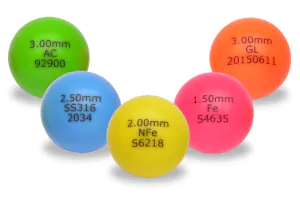
Test balls are certified pipeline and gravity-feed validation standards for both metal detection and X-ray inspection systems. Each ball is a low-density, impact-resistant plastic housing with a Grade 200 certified precision ball visibly enclosed — providing a consistent, traceable contaminant signature in free-fall, bagger, bulk flow, and batch mixing environments.
System Compatibility: Metal detection and X-ray inspection systems (TB13 - 1″ (25mm) · )
Compliance: FDA-compliant materials; suitable for food processing and pharmaceutical manufacturing environments
Traceability: Color-coded; permanently imprinted with size, contaminant type, and unique CoC number
Documentation: NIST/ISO Certificate of Compliance available with every order
Price: $30.00 per unit
Frequently Asked Questions
Metal Detector & X-Ray Test Balls — Pipeline & Gravity-Feed Validation
Test balls are available in five standard diameters: 5/8″ (15mm), 3/4″ (19mm), 1″ (25mm), 1-1/4″ (32mm), and 1-1/2″ (38mm). Size selection is typically driven by your HACCP program, food safety standard, or equipment OEM recommendation — choose the smallest diameter your validation protocol requires to be reliably detected at your pipeline aperture and product conditions.
All six standard contaminant types are available: Ferrous (FE, 7.80 g/cc), Non-Ferrous (NF, 8.47 g/cc), Stainless Steel 316 (SS316, 7.95 g/cc), Stainless Steel 304 (SS304, 7.95 g/cc), Stainless Steel 440 (SS440, 7.70 g/cc), and Aluminum (AL, 2.79 g/cc). Most food and pharmaceutical validation programs require SS316 as the minimum sensitivity benchmark; AL challenges low-density detection performance. All six types are available in every ball size.
The test ball is introduced into the product stream above the detector aperture and flows through freely with product — or is introduced during a momentary line pause for direct challenge testing. The metal detector must trigger a reject event when the ball passes through, confirming the system can reliably detect a contaminant of that material and diameter at that point in the line. The round geometry also makes test balls ideal for bagger and free-fall gravity chute systems where flat or rod-shaped standards would not flow naturally.
Yes. The low-density plastic housing is radiolucent, making the enclosed precision ball fully visible to X-ray inspection systems while still presenting a metallic signature to the metal detector coil. On combination metal detector + X-ray lines, a single test ball can challenge both technologies in one pass, simplifying your test kit and reducing the number of separate standards required per shift check.
The housing is manufactured from low-density, impact-resistant FDA-compliant plastic that is durable enough to survive repeated passes through high-velocity flow systems without deforming or cracking. The low density ensures the housing adds no metallic or high-density X-ray signature of its own — the only detectable signal comes from the precision ball inside. The visible enclosure also makes the ball easy to locate and retrieve from a reject chute after each test pass.
Grade 200 is an ABMA/ISO dimensional classification defining the maximum allowable deviation in diameter and sphericity for each enclosed precision ball. Certification to Grade 200 ensures every test ball presents a consistent, repeatable contaminant cross-section to the detection system, so challenge test results are comparable across runs, across shifts, and between facilities using identical standards.
Yes. FDA-compliant construction and NIST/ISO Certificate of Compliance documentation make these test balls suitable for metal detector qualification in pharmaceutical manufacturing environments operating under GMP, USP requirements, and 21 CFR Part 211. The CoC provides the traceable reference documentation required for IQ/OQ/PQ validation protocols and FDA audit readiness.
Test balls with traceable CoC documentation satisfy the metal detection CCP (Critical Control Point) challenge testing requirements of HACCP plans, BRC Global Standard for Food Safety, SQF Code, and FSSC 22000. Each CoC ties a specific ball (by size, contaminant type, and serial number) to a documented standard, providing the written evidence auditors require to verify your detection system is being challenged with a certified, known-specification test piece.
Ball size should match the minimum detectable contaminant diameter specified in your food safety plan, retailer code of practice, or equipment OEM qualification documents. In general, smaller apertures and higher product effects require larger test standards to achieve reliable detection, while wide-aperture low-effect pipelines can validate with smaller sizes. When in doubt, start with the sensitivity specification in your HACCP plan or contact your metal detector manufacturer for the minimum sphere size achievable at your aperture and product conditions.
Every order includes a NIST/ISO Certificate of Compliance (CoC) documenting the ball diameter, contaminant type, material density, Grade 200 certification, and a unique CoC serial number. The physical ball is color-coded by contaminant type and permanently imprinted with this information, creating a direct link between the standard and its paperwork that satisfies traceability requirements during HACCP, BRC, SQF, FSSC 22000, GMP, and FDA audit events.
Why Choose Test Standard Labs?
Trusted by 1,000+ facilities worldwide
20+
Years Experience
Since 2004
1,000+
Satisfied Customers
Worldwide
100%
NIST Traceable
Certified Quality
24hr
Fast Shipping
Same-Day Available
Ready to Order?
Join 1,000+ facilities that trust Test Standard Labs for their quality control needs