
Sticks & Wands
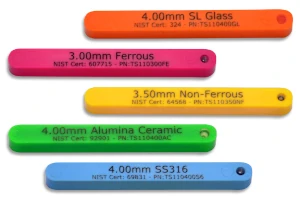
Metal Detector & X-Ray Inspection System Test Sticks and Wands
When standard test cards are insufficient, our high-visibility **Test Sticks and Wands** provide the ideal solution for large-format and deep inspection system validation. Designed for use in both **Metal Detector** and **X-Ray Inspection Systems**, these standards ensure system integrity using a **certified grade 200 precision ball** visibly enclosed.
All testing products are precisely manufactured utilizing **FDA-compliant materials** and include full traceability.
Available Models and Sample Capacity
| Model | Metric Size (L x W x H) | Max Sample Size |
|---|---|---|
| Probe Model | 3mm x 10mm x 50mm | 3.50mm |
| 2" Long Model | 10mm x 10mm x 50mm | 8.00mm |
| 4" Long Model | 10mm x 10mm x 100mm | Unlimited* |
| 6" Long Model "Wand" | 10mm x 10mm x 150mm | 8.00mm |
*The 4" Long Model offers the largest format for testing maximum theoretical sample sizes.
Traceability and Documentation
- **Traceability:** Each stick/wand is **Color-coded**, imprinted with size, contaminant type, and a unique Certificate of Compliance (CoC) number.
- **Certification:** All necessary **Certificates of Compliance** are available to meet strict auditing and quality control requirements.
Frequently Asked Questions
Test Sticks & Wands - Selection and Usage Guide
Test sticks and wands are designed for applications where standard test cards are insufficient or impractical. The key differences:
Size and Format:
- Test Cards: Compact (credit card size), flat format. Best for standard products and regular validation testing.
- Test Sticks: Extended rod/wand format (2"-6" long). Designed for large products, deep inspection zones, and bulk containers.
Visibility: Test sticks feature high-visibility housing with a certified grade 200 precision ball visibly enclosed, making them easier to track through large systems and bulk materials. Cards rely on lower-profile embedded samples.
Applications:
- Use Test Cards For: Standard packaged products, routine validation, aperture testing, products under 8" in any dimension
- Use Test Sticks For: Bulk bags/totes, large cartons, deep tunnel metal detectors, products over 8", x-ray systems with thick products, cases where high visibility is critical
Both are NIST traceable, FDA compliant, and include Certificates of Compliance. Many facilities use both: cards for routine testing and sticks for specialized applications. Contact us if you need help determining which is right for your operation.
Model selection depends on your product size, inspection system configuration, and testing requirements:
Probe Model (3mm x 10mm x 50mm, Max 3.50mm):
- Best For: Small to medium products, tight apertures, pouches, sachets, small boxes
- Advantages: Compact profile fits through narrow apertures, suitable for smaller metal detectors
- Limitations: Smaller test piece size (3.50mm max), may be difficult to track in very large products
2" Long Model (10mm x 10mm x 50mm, Max 8.00mm):
- Best For: Medium to large products, standard validation, general-purpose testing
- Advantages: Good visibility, versatile sizing, cost-effective
- Common Applications: Boxed products, medium bags, case validation
4" Long Model (10mm x 10mm x 100mm, Unlimited Testing):
- Best For: Large products, bulk containers, deep tunnel systems, maximum theoretical testing
- Advantages: Longest format, unlimited sample capacity, excellent visibility in bulk materials
- Common Applications: Bulk bags (totes/supersacks), large cartons, pallet-load validation, ingredient drums
6" Wand Model (10mm x 10mm x 150mm, Max 8.00mm):
- Best For: Very deep inspection zones, extended tunnel systems, extremely large products
- Advantages: Maximum penetration depth, high visibility even in very large products
- Common Applications: Deep tunnel metal detectors, large crate validation, specialty bulk applications
Quick Selection Guide: Product < 3" any dimension = Probe Model. Product 3-8" = 2" Model. Product > 8" or bulk containers = 4" Model. Deep tunnels or very large crates = 6" Wand. Still unsure? Contact our technical team for personalized guidance.
Large tunnel metal detectors require specific validation procedures to ensure complete coverage of the inspection zone. Test sticks are specifically designed for this application:
Step 1: Select Appropriate Model
- Tunnel depth < 4": Use 2" Long Model
- Tunnel depth 4-6": Use 4" Long Model (recommended for most tunnels)
- Tunnel depth > 6": Use 6" Wand Model
- Match test piece size to your critical control point (smallest contaminant you must detect)
Step 2: Zone Testing Procedure
- Center Zone: Pass test stick through the geometric center of the tunnel aperture
- Edge Zones: Test each corner and midpoint of aperture edges (minimum 8 positions for rectangular apertures)
- Product-Loaded Testing: For most accurate validation, place test stick inside typical product packaging or simulate product matrix
- Orientation Testing: Test in multiple orientations (horizontal, vertical, diagonal) as metal detector sensitivity varies by orientation
Step 3: Documentation
- Record date, time, test piece details (size, material, CoC number from stick imprint)
- Document all test positions and results (detect/reject for each zone)
- Note any system adjustments or failures
- Maintain Certificate of Compliance from test stick in quality records
- Link validation records to HACCP documentation
Frequency: HACCP plans typically require validation at start-up, after any equipment adjustment, and at defined intervals (often hourly or per production lot). Your HACCP team establishes the specific frequency based on risk assessment.
The high-visibility housing of test sticks makes them ideal for tunnel systems—operators can easily see the test piece enter and confirm reject mechanism activation. The extended length ensures the test piece penetrates deeply into the inspection zone, validating coverage throughout the tunnel depth.
Yes, test sticks are fully reusable and designed for thousands of validation cycles. Unlike consumable testing methods, our test sticks provide a cost-effective, long-term validation solution.
Durability and Lifespan:
- Construction: Solid FDA-compliant plastic housing with permanently enclosed certified precision ball—no moving parts to wear out
- Typical Lifespan: 3-5 years with normal use and proper care
- Test Cycle Capacity: Thousands of validation tests per stick with no degradation in performance
- Material Stability: The test piece material is dimensionally stable and does not corrode, oxidize, or change properties over time
Care and Maintenance:
- Cleaning: Wash with mild soap and water between uses if contaminated with product. Dry thoroughly before storage.
- Storage: Store in a clean, dry location away from extreme temperatures. Keep with Certificate of Compliance for traceability.
- Handling: Avoid dropping on hard surfaces or subjecting to impact that could crack the housing
- Inspection: Regularly inspect for cracks, chips, or damage to the housing. The test piece must remain fully enclosed.
When to Replace:
- Physical Damage: Any cracks, chips, or breaks in the housing that could expose the test piece
- Imprint Wear: If the size/CoC number imprinting becomes illegible (affects traceability documentation)
- Color Degradation: Significant fading of the color-coding (impacts visibility and identification)
- Loss of Certificate: If the Certificate of Compliance is lost and cannot be obtained (some auditors require it)
Cost Comparison: Reusable test sticks are significantly more economical than single-use test pieces or consumable alternatives when considering the cost per validation over the product lifespan. One test stick can perform thousands of validations, reducing your per-test cost to pennies.
No Recertification Required: Unlike some test equipment, test sticks do not require periodic recertification or calibration. The precision ball is permanently certified at manufacture and maintains its specifications indefinitely.
Yes, our test sticks are dual-purpose and work effectively in both metal detector and X-ray inspection systems. This versatility makes them an excellent choice for facilities using multiple types of inspection equipment.
Metal Detector Applications:
- Detection Mechanism: The embedded metal test piece (ferrous, non-ferrous, or stainless steel 316) triggers the metal detector's electromagnetic field
- Best For: Validating metal detector sensitivity, zone testing, aperture verification
- Metal Types Available: Ferrous (most sensitive), Non-Ferrous (intermediate sensitivity), Stainless Steel 316 (least sensitive—most challenging test)
X-Ray System Applications:
- Detection Mechanism: The metal test piece appears as a high-density object in X-ray images, triggering reject algorithms
- Best For: Validating X-ray system functionality, testing image analysis algorithms, verifying reject mechanisms
- Advantage: Metal test pieces provide very clear X-ray contrast—easy for systems to detect and good for validation
- Note: For X-ray-specific validation (glass, ceramic, stone detection), we also offer test sticks with glass/ceramic test pieces. Contact us for these specialized options.
Dual-System Facilities:
Many food processing and pharmaceutical facilities use both metal detection and X-ray inspection in a layered approach:
- Metal Detector: First line of defense for all metallic contamination
- X-Ray Inspection: Secondary inspection for non-metallic hazards (glass, stone, bone) and verification of metal detection
Using the same test sticks across both systems simplifies your validation program—fewer SKUs to manage, consistent documentation, and reduced training complexity. Operators can use one set of test sticks to validate multiple systems.
Important: While test sticks work in both systems, your HACCP plan should specify which validation tools are used where. Some applications require system-specific testing (for example, validating X-ray glass detection requires glass test pieces). Contact our team for guidance on building a comprehensive validation program.
Every test stick is individually certified with full NIST traceability and comes with comprehensive documentation to meet the strictest auditing requirements.
NIST Traceability:
- Certification Path: Each test piece is manufactured to precise specifications traceable to NIST (National Institute of Standards and Technology) standards
- Grade 200 Precision Ball: The enclosed metal test piece is a certified Grade 200 precision ball with documented dimensional accuracy and material composition
- Manufacturing Standards: Test sticks are manufactured under ISO-compliant quality management systems
- Batch Control: Each production batch undergoes verification testing to ensure consistency
Physical Identification:
- Color Coding: Each test stick is color-coded by metal type (ferrous, non-ferrous, stainless steel) for quick visual identification
- Imprinted Information: Permanently imprinted on each stick: test piece size (mm), contaminant type, unique Certificate of Compliance (CoC) number
- Tamper-Evident Design: The test piece is permanently enclosed—no way to remove or alter without destroying the stick
Certificate of Compliance (CoC):
- Unique Number: Each stick's CoC number links to specific certification documentation
- Downloadable: Certificates are available for download from our website using the CoC number (no charge)
- Certificate Contents: Test piece specifications, material composition, dimensional accuracy, NIST traceability statement, manufacturing date, batch information
- Audit Support: CoC satisfies most third-party audit requirements (SQF, BRC, FSSC 22000, GFSI schemes)
FDA Compliance:
- Food Contact Safe: All materials meet FDA regulations for indirect food contact (21 CFR 177)
- Material Safety: Housing material is FDA-compliant plastic suitable for food manufacturing environments
- Pharmaceutical Grade: Suitable for pharmaceutical and nutraceutical applications
HACCP Documentation: The Certificate of Compliance, combined with the stick's imprinted information, provides the traceability documentation required for HACCP critical control point verification. Auditors can verify the test piece specifications match your established critical limits and confirm NIST traceability.
Maintaining Records: Best practice is to store the Certificate of Compliance with your HACCP documentation and reference the CoC number in validation logs. This creates a complete audit trail linking each validation test to certified, traceable test standards. Lost a certificate? Contact us with your CoC number for a replacement copy.
Yes, test sticks are specifically designed for bulk container validation and are often the ONLY practical solution for these applications. Standard test cards are impractical or impossible to use in bulk materials.
Why Test Sticks Excel for Bulk Validation:
- High Visibility: The extended rod format and colored housing remain visible even when partially buried in bulk materials
- Easy Placement: Can be intentionally placed at different depths and positions within bulk containers
- Easy Retrieval: The rod extends above the product surface, allowing easy removal after testing
- Adequate Size: The 4" Long Model provides sufficient length to penetrate deep into bulk materials while remaining visible
Common Bulk Applications:
Totes and Supersacks (IBCs):
- Challenge: 500-2,000 lb containers of ingredients, often 3-4 feet deep
- Solution: Use 4" Long Model. Place test stick at various depths (surface, mid-depth, bottom) to validate full container coverage
- Recommended Model: 4" Long Model (unlimited sample capacity handles large product mass)
- Test Procedure: Insert stick vertically into bulk material, pass entire container through metal detector or X-ray system, verify detection and retrieval
Ingredient Drums and Barrels:
- Challenge: Deep cylindrical containers, often 200-400 lbs of material
- Solution: 4" Long Model inserts from top, extends deep into container while remaining visible for retrieval
- Multiple Positions: Test center, off-center, and near walls to validate full drum cross-section
Bulk Bags on Pallets:
- Challenge: Large bags stacked on pallets create thick, dense inspection challenges
- Solution: Place test stick between bags or insert into individual bags before stacking
- Tunnel Systems: For pallet-load metal detectors, use 6" Wand Model if tunnel is particularly deep
Validation Best Practices for Bulk:
- Simulate Real Contamination: Place test stick in positions where actual contamination would likely occur (often at filling ports or bag seams)
- Document Depth: Record the depth/position of test piece placement for audit trails
- Account for Product Effect: Bulk materials often have high product effect (moisture, density, salt content). Test with product present to validate realistic detection capability
- Consider Compaction: Test pieces may shift position as bulk materials settle. Plan retrieval strategy accordingly
- Frequency: HACCP plans typically require validation for first container of each lot and periodically throughout production run
Alternative Solutions: Some facilities use metal detection at ingredient receiving before materials go into bulk containers, reducing the need for bulk container inspection. However, if you do final product bulk inspection or use checkweigh-reject systems, test sticks are the standard solution. Contact us to discuss your specific bulk validation requirements.
Maximum theoretical sample size refers to the largest test piece a given model can accommodate based on its physical dimensions. The 4" Long Model's "unlimited" capacity is a significant advantage for testing large products and systems.
Understanding Sample Capacity:
- Physical Constraint: The housing dimensions limit the maximum size of test piece that can be enclosed
- Probe Model (3mm x 10mm x 50mm): Maximum 3.50mm test piece—the narrow housing cannot accommodate larger sizes
- 2" and 6" Models (10mm x 10mm): Maximum 8.00mm test piece—the 10mm housing width limits test piece size
- 4" Long Model (10mm x 10mm x 100mm): The extended length (100mm) allows for any test piece size we manufacture—hence "unlimited"
Why "Unlimited" Matters:
- Future-Proofing: If you later need larger test pieces (for less sensitive systems or challenging products), the 4" model can accommodate them without needing a different test stick
- Flexibility: Some applications require testing with multiple test piece sizes. The 4" model housing works with any size, reducing inventory needs
- Bulk Applications: Large bulk containers with high product effect may require larger test pieces. The 4" model doesn't limit your testing capability
Practical Test Piece Size Selection:
While the 4" model CAN accommodate any size, you should still select test piece sizes based on your critical control points:
- Match System Capability: Use the smallest test piece size your system can reliably detect in your product—this validates your actual critical limit
- Consider Product Effect: Dense or moist products reduce detection sensitivity. You may need larger test pieces than with light, dry products
- HACCP Requirements: Your hazard analysis determines the minimum detectable contaminant size. Test pieces should match or be slightly smaller than this critical limit
- Realistic Hazards: A 0.5mm test piece may be detectable but isn't a realistic choking or injury hazard. Choose sizes that represent actual risk
Model Comparison:
- Need test pieces 3.50mm or smaller only: Probe Model is sufficient and more economical
- Need test pieces up to 8.00mm: 2" or 6" Models work well (choose based on length requirements)
- May need test pieces larger than 8.00mm: 4" Long Model is the only option
- Unsure of future needs: 4" Long Model provides maximum flexibility
Technical Note: The "unlimited" designation refers to our current product line (test pieces up to approximately 10mm). If specialized applications require test pieces larger than 10mm, contact us about custom solutions. For most food safety and pharmaceutical applications, test pieces are typically in the 1.0-6.0mm range.
No, test sticks do not expire and do not require periodic recertification. This is a significant operational and cost advantage compared to some other testing equipment.
Why No Recertification is Needed:
- Stable Materials: The metal test piece (precision ball) is manufactured from dimensionally stable materials that do not corrode, oxidize, or change composition over time
- Permanent Enclosure: The test piece is permanently sealed in the housing—no way for environmental factors to affect it
- Physical Standard: Unlike electronic instruments that drift out of calibration, physical test pieces maintain their properties indefinitely
- Initial Certification Sufficient: NIST traceability is established at manufacture and doesn't expire as long as the test piece remains intact
Practical Lifespan:
- Typical Usage: 3-5 years with normal handling and proper care
- Limiting Factors: Wear and tear on housing (cosmetic), not degradation of test piece
- Indefinite if Undamaged: If the housing remains intact with no cracks or exposure of the test piece, the stick remains valid indefinitely
Replacement Criteria (Condition-Based, Not Time-Based):
- Physical Damage: Cracks, chips, or breaks that could compromise the housing integrity
- Test Piece Exposure: If the housing breaks and exposes the test piece, the stick must be replaced (safety and traceability concerns)
- Illegible Markings: If the imprinted size/CoC number wears off and becomes unreadable (affects documentation)
- Significant Color Loss: If color-coding fades to the point where identification is difficult (reduces visibility and increases error risk)
Comparison to Alternatives:
- Some Test Pieces: Competitors may claim expiration dates (often a marketing strategy rather than technical necessity)
- Embedded Wire Test Pieces: Wires can break or shift inside cards over time (our permanently enclosed design prevents this)
Maintaining Audit Compliance:
While test sticks don't expire, auditors may ask questions. Be prepared to show:
- Certificate of Compliance: Demonstrates initial NIST traceability (keep with stick or in quality files)
- Purchase Records: Shows when stick was acquired (for replacement planning)
- Inspection Records: Document periodic visual inspections of test stick condition (demonstrates proactive quality management)
- Functional Verification: Your metal detector/X-ray validation logs demonstrate the stick continues to perform as expected
Cost Savings: No recertification requirement means you avoid recurring service fees, administrative overhead of managing calibration schedules, and downtime for sending equipment out for recertification. Once purchased, test sticks provide thousands of validations with essentially zero ongoing cost beyond basic care. This makes them one of the most cost-effective validation tools available.
If an auditor questions the lack of recertification, explain that physical test pieces with stable materials and permanent enclosures do not require recertification per NIST traceability standards. The functional performance verification through your validation testing demonstrates ongoing fitness for use.
Why Choose Test Standard Labs?
Trusted by 1,000+ facilities worldwide
Ready to Order?
Join 1,000+ facilities that trust Test Standard Labs for their quality control needs
1 Item